Iron & Grace • The Rider • Motorcycle Licence • AVB • AVB Exercises Explained
Emergency Stop
You’re riding through town when suddenly a ball rolls into the road right in front of you. At that moment, you don’t want to be thinking about which brake to use. You want to know how to bring the motorcycle to a stop as quickly and safely as possible.
That’s exactly what the emergency stop is about. You demonstrate that you can brake firmly using both brakes while maintaining control of the motorcycle. There’s no time to gradually reduce your speed. You need to know what to do and trust the technique you’ve been practising.
How does it work?
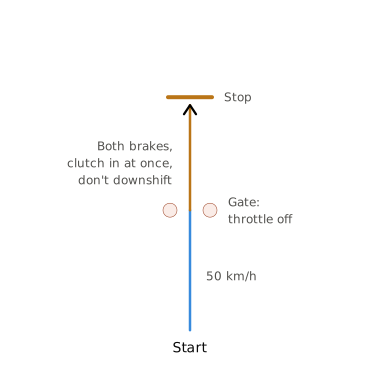
You approach at approximately 50 km/h. As soon as you pass through the marker gate, close the throttle, pull in the clutch and brake firmly using both the front and rear brakes.
Apply the braking pressure quickly but progressively. The front brake provides most of the stopping power, while the rear brake also plays an important role. The aim is to bring the motorcycle to a complete stop as quickly as possible without losing control.
Where can things go wrong?
A common mistake is looking down. Some learners glance at the dashboard to check their gear or speed, for example. This takes their eyes away from the direction of travel, when looking ahead is particularly important during hard braking.
Another common problem is braking too cautiously. The front brake provides most of the stopping power. If you rely mainly on the rear brake because you’re hesitant to use the front one, you’re not making full use of the braking power available.
There’s also the fact that 50 km/h can feel faster than it really is, especially when you know you’re about to brake hard. As a result, some learners instinctively hold back, when what they need to do is trust their brakes and the technique they’ve been practising.
Tips
- Make sure you’re travelling at 50 km/h and in the correct gear before passing through the marker gate.
- Use both brakes and trust the stopping power of the front brake.
- Build up the braking pressure quickly and progressively.
- Keep looking ahead, even when braking firmly.
My experience
What I found difficult at first was the idea of riding at 50 km/h before having to brake as hard as possible. It felt a little contradictory. You know what’s coming, yet you still have to build up speed first.
During the lessons, I realised that the motorcycle had much more stopping power than I had initially thought. Once I learned to trust that, the exercise became considerably easier. In the end, the hardest part wasn’t the braking itself, but letting go of my own hesitation.
Looking towards the horizon also helped. Once I stopped looking down at the front wheel or dashboard, the whole braking process felt calmer and more controlled.
Official CBR description
“In the fourth cluster, the emergency stop is a mandatory exercise. You first ride at 50 km/h. After the gate, you close the throttle, immediately disengage the clutch, and brake as hard as possible to come to a stop in the shortest distance. Both brakes are used, with the front brake being the most important. Control of the motorcycle must not be lost.”
Discover More
Getting your motorcycle licence is just one way to explore the world of Bonvia. There is so much more to discover.
Hub
AVB Explained
Every AVB exercise has its own purpose and challenge.
From slow manoeuvres that test your balance to exercises that call for quick reactions and precise control. Explore the exercises one by one, discover how they are performed and learn what to pay attention to.
Discover AVB Explained ✦