
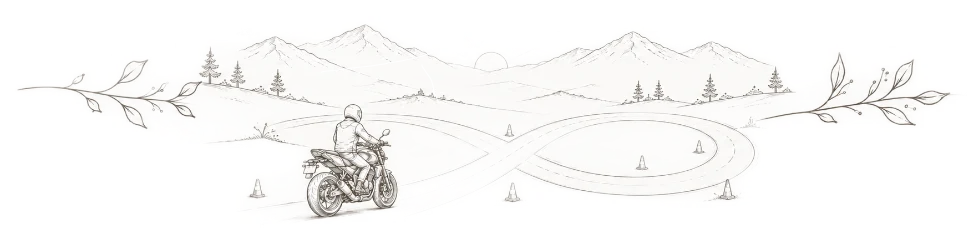
Deceleration Exercise
The deceleration exercise combines several skills in one: accelerating, braking, and immediately continuing into a slalom.
In real traffic, this feels like situations where you need to adjust your speed without coming to a complete stop. Traffic slowing down ahead, a corner that turns out tighter than expected, or an obstacle you need to steer around.
It teaches you how to switch between accelerating, braking and steering without the motorcycle becoming unstable or losing control.

How do you do it?
You ride away from a standstill and accelerate smoothly up to around 50 km/h. While doing so, you shift up to at least third gear.
At the second gate, you close the throttle, brake in a controlled way, and shift down one gear. You reduce your speed to around 30 km/h before entering the slalom.
Once you start the slalom, braking is finished and the clutch is fully released. From that moment on, you steer the bike smoothly between the cones.

Where do things go wrong?
This exercise often feels difficult because so many things happen at once. Students tend to break it into separate tasks: accelerate, brake, shift, slalom. That creates tension and disrupts flow.
A common mistake is not shifting up to third gear in time, which causes everything to happen at the last moment before braking. Another frequent issue is starting the slalom while still braking or before the clutch is fully released. That makes the bike unstable.

Tips
- Think ahead instead of step-by-step
- Make sure you are already in third gear before the braking point
- Complete the braking phase before entering the slalom
- Release the clutch fully before you start steering
- Look further ahead than the next cone
- Treat it as one flowing movement, but finish each phase properly before moving on

My experience
On paper, this exercise looks simple. In reality, it can feel quite overwhelming because so much is happening at once.
First you build speed, then shift to third gear, then brake firmly, shift down, and finally enter the slalom. In the beginning, that created a lot of mental noise.
What helped most was making sure I was always ahead of the bike. Reaching 50 km/h early, shifting in time, and completing each step before the next one started.
Once everything became more structured, the exercise started to feel much calmer.


Official CBR description
“You accelerate from a standstill up to a speed of fifty kilometres per hour. You are at least in third gear. At the second gate, you close the throttle, brake immediately using both front and rear brakes, and shift down one gear. You must complete the deceleration before entering the slalom. The braking phase is finished and the clutch is released.
You enter the slalom at a speed of thirty kilometres per hour. The slalom consists of three cones placed eight metres apart and is ridden with a lightly driving engine. This exercise shows that you can accelerate and decelerate within a limited distance. You are prepared in time and demonstrate that you can maintain a smooth and controlled rhythm through the slalom.”

IRON & GRACE • Riding Notes
If you enjoyed this, you might also like:
Motorcycle licence journey
From your first lesson to riding independently.
Dutch CBR motorcycle licence system
Basic vehicle control test: AVB
The first time a motorcycle really starts to feel like yours. Dutch AVB test (CBR off-road manoeuvring)
AVB exercises explained
Everything you need to know about the AVB manoeuvring exercises. Dutch CBR AVB exercises