Iron & Grace • The Rider • Motorcycle Licence • AVB • AVB Exercises Explained
Slow Slalom
The slow slalom is one of the most challenging parts of the Dutch AVB motorcycle handling exam for many learners. That might sound strange, given that you are riding at a very low speed. But that is exactly what makes it difficult.
A motorcycle is built to move. When you ride at little more than walking pace, you have to work much more consciously with your balance, vision and the use of the clutch and rear brake. Everything comes together in one continuous movement where control matters more than speed.
What makes this exercise so useful is that it teaches you to keep the motorcycle calm and controlled when you have very little speed to rely on. That skill comes in handy later in everyday traffic: manoeuvring slowly through a busy festival car park, riding among pedestrians or carefully moving across a wet road. In all these situations, the principle is the same: keeping the motorcycle stable and under control, even at low speeds.
How does it work?
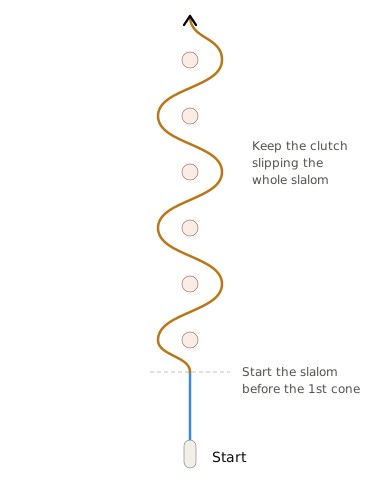
You ride at walking pace between a series of cones placed relatively close together. It is not just about steering, but mainly about maintaining your balance while the motorcycle seems almost stationary. To do this, you continuously combine clutch control, the rear brake and body balance.
The examiner is not just looking at whether you touch the cones, but whether you keep the motorcycle under control throughout the exercise. Calmness and control matter more than speed or perfection.
You keep the clutch at the friction point, giving the motorcycle just enough drive to keep moving without picking up too much speed. You use the rear brake to control your pace, because at such low speeds the motorcycle can quickly start moving faster than you intend.
Your posture should remain relaxed, and your eyes should stay ahead. Don’t look at the cone you are passing, but at the next one and the line you want to follow. This often makes the biggest difference. The further ahead you look, the more stable the motorcycle feels and the easier it becomes to follow the slalom.
Where can things go wrong?
The biggest pitfall is tension. Many learners stiffen their arms and try to steer the motorcycle actively between the cones. This makes the bike unsettled and the exercise feels more difficult than it needs to be.
Another common mistake is looking at the cone as you pass it. Understandable, but a motorcycle tends to follow your gaze. If you look at the cone, there is a good chance you will end up riding towards it.
Another mistake is reaching for the front brake when the motorcycle starts to feel unbalanced. At low speeds, especially with the handlebars turned, this can make the motorcycle brake abruptly and tip over. The rear brake is your friend here. Keep your hands off the front brake.
Tips
- Look at the next cone, not the one beside you.
- Keep your arms relaxed.
- Hold the motorcycle lightly between your legs.
- Use the rear brake to control your speed.
- Keep the clutch steady at the friction point.
- Trust that the motorcycle has more balance than you might think.
- Stay off the front brake.
My experience
This was perhaps the most difficult exercise of my entire AVB training. Riding a heavy motorcycle at walking pace felt unnatural at first. Whenever I felt myself losing balance, my instinct was to correct with the handlebars or put a foot down.
What eventually helped was accepting that the motorcycle was allowed to move a little. Once I relaxed and started looking further ahead towards the next cone, things gradually became easier. It also helped to guide the motorcycle more with my hips, rather than pulling it through the turns with the handlebars.
At first, I was also too focused on riding slowly. It worked better to simply let the motorcycle move through the slalom as slowly as possible, without constantly worrying about the speed.
Looking back, I think this exercise taught me above all to trust the motorcycle. Technique is important, but it was only when I relaxed and let the motorcycle do what it was designed to do that everything started to feel more natural.
Officiële CBR-omschrijving
“The compulsory exercise in the second cluster is the slow slalom. There is no fixed speed requirement. Given the short distance between the cones, a walking pace is expected. The use of a slipping clutch is mandatory. The combination of correct control, slow riding and maintaining balance is essential. The cones must not be touched.”
← Previous exercise
Current exercise
Slow slalom
Next exercise →
Discover More
Getting your motorcycle licence is just one way to explore the world of Bonvia. There is so much more to discover.
Hub
AVB Explained
Every AVB exercise has its own purpose and challenge.
From slow manoeuvres that test your balance to exercises that call for quick reactions and precise control. Explore the exercises one by one, discover how they are performed and learn what to pay attention to.
Discover AVB Explained ✦