
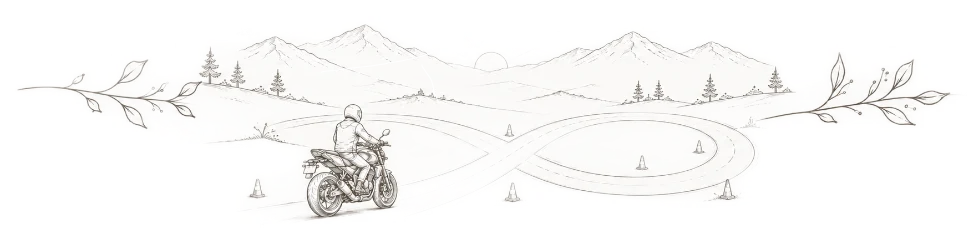
Evasive Manoeuvre
The evasive manoeuvre is one of the more demanding exercises in the AVB test. It is also one of the first moments where everything you have learned starts to feel like real-world riding.
The cones in front of you represent an unexpected obstacle: a stationary car, a wall that suddenly appears, or an animal crossing the road. Situations where you do not have time to think — only to react.
That is exactly what this exercise is about. Not just technique, but trust in your own reaction and in what the motorcycle can do.
You learn that avoiding danger is not always about braking. Sometimes, the safest option is a quick and controlled change of direction.

How do you do it?
You approach the exercise at around 50 km/h. At that speed, you are fully in motion, which means your reaction has to be immediate.
Just before the obstacle, you close the throttle and steer the motorcycle quickly and decisively around the cones. After that, you guide the bike back into your original lane.
The focus is not only on avoiding the obstacle, but on maintaining control during a sudden change of direction. You show that you can lean the motorcycle and steer quickly without losing stability.
Braking is not allowed. At first, this feels unnatural, because your instinct tells you to slow down. But this exercise is about steering instead of braking. If you brake first, you lose both time and space. By committing to the manoeuvre, you keep the control you need.
In the end, it comes down to one thing: trusting the motorcycle when braking is no longer an option.

Where do things go wrong?
A common mistake is looking at the cones. The bike follows your eyes, so if you focus on the obstacle, you increase the chance of riding towards it instead of away from it.
Another issue is hesitation. Steering too gently makes the movement too wide, leaving not enough space to return to your lane.
Some learners still brake during the exercise. This is not allowed and also reduces the bike’s ability to respond quickly when it matters most.

Tips
- Always look at the clear space next to the obstacle
- Close the throttle, but do not brake
- Steer quickly and decisively
- Keep your arms and shoulders relaxed
- Trust that the motorcycle can lean more than it feels like it can

My experience
At first, it feels quite intense to approach the cones at speed without braking, then steer left, and immediately return to the right again.
But in practice, the exercise becomes easier than expected. Once the first evasive movement is done, the second part feels more like a natural follow-up motion. At the same time, the motorcycle is already slowing down because the throttle is closed.
That makes the first part feel much faster than the second. And strangely enough, that brings more calm — because you realize the hardest part is already behind you after the first movement.


Official description
“If this exercise is selected, you approach the course at 50 km/h through the gate. After the gate, you close the throttle. You then steer left in front of the obstacle made of cones and return to your original lane. The key point is to demonstrate that you can lean and control the motorcycle during a sudden evasive action.”

IRON & GRACE • Riding Notes
If you enjoyed this, you might also like:
Motorcycle licence journey
From your first lesson to riding independently.
Dutch CBR motorcycle licence system
Basic vehicle control test: AVB
The first time a motorcycle really starts to feel like yours. Dutch AVB test (CBR off-road manoeuvring)
AVB exercises explained
Everything you need to know about the AVB manoeuvring exercises. Dutch CBR AVB exercises