Congo: What It Takes to Enter the Rainforest
Six expeditions. Twelve months. One journey beyond the familiar.
Sometimes you see footage of an expedition and the task seems almost straightforward. A river, a kayak, a destination hundreds of kilometres away. Follow the water and keep paddling until you get there.
But what happens when the river has other plans? When you cannot simply draw drinking water from the water around you, your body struggles to cool down, and the nearest medical help may be days away?
These are the questions that come to mind when I look at the first mission of Project 6.
Welsh adventurer Ash Dykes plans to undertake six expeditions in twelve months, each in a different environment. He has already completed demanding journeys through places such as Mongolia and Madagascar, and along China’s Yangtze River. With Project 6, he is setting himself another considerable challenge: six missions, with limited time at home to recover and prepare for the next.
The first destination is the Congo Basin. Together with filmmaker Will Pérez and local guide Obed Temba, Ash plans to travel by inflatable kayak from Nola in the Central African Republic to Mossaka in the Republic of the Congo. The route follows the Sangha River for more than 700 kilometres.
It sounds like a journey that demands endurance above all else. But the more you consider the environment, the clearer it becomes that distance is only one part of the challenge.
A River Through a Living Landscape
The Congo Basin contains the world’s second-largest tropical rainforest, after the Amazon. It stretches across several countries in Central Africa, forming a vast network of forests, rivers, wetlands and other ecosystems.
The Sangha is part of the Congo River drainage system. It flows through a landscape where water and forest are closely connected. From the river, you can see dense vegetation along the banks, but what lies beyond it is not always easy to make out.
The region is home to a remarkable variety of wildlife, including forest elephants, western lowland gorillas and chimpanzees. Hippos and crocodiles also live in and around its waterways. The river is not simply an expedition route; it is the habitat of animals that have no reason to welcome people into their surroundings.
Nor is the rainforest uninhabited. Communities have lived in and around these forests for generations. The Ba’Aka have an extensive knowledge of their environment, built through experience and passed down from one generation to the next.
Before setting out, Ash hopes to spend time with members of the Ba’Aka community and learn from their knowledge of the forest. I think this is an important part of the story. Understanding a landscape means more than knowing which animals live there or where a river leads. It also means paying attention to the people who call it home and to the ways in which their lives are connected to their surroundings.
Anyone planning an expedition through this region needs more than a map. They need to begin by understanding the kind of landscape they are entering.
The River Does Not Decide Everything, but It Matters
On a map, a river can look like a clear line leading from one place to another. On the water, that line is far less predictable.
Currents can change, water levels vary with the seasons, and not everything beneath the surface is visible. Floating timber, submerged obstacles, shallow stretches and changing conditions can all affect the route. Dense vegetation along the banks may also limit the places where it is possible to come ashore.
For a kayaking expedition, distance alone tells us very little. It is not enough to calculate how many kilometres you hope to cover each day. You also need to consider the conditions on the water, where you can safely stop and where you might spend the night.
The weather matters too. In a tropical environment, heat, high humidity and heavy rainfall can change conditions considerably. Rain may reduce visibility, affect the river and make it harder to keep equipment dry.
These are not necessarily dramatic hazards that cause trouble every day. They are conditions that need to be considered throughout the journey. On a long expedition, small changes can eventually have a significant effect.
Learning from the People Who Know the Land
The Sangha takes the team through a landscape many people know mainly from photographs and documentaries. For the people who live there, however, the rainforest is much more than an impressive backdrop.
During the first days, Ash and his team spend time with members of the Ba’Aka community. They learn about their knowledge of the forest, traditional ways of finding food and how people live alongside their surroundings.
They also head into the forest with local guides in search of forest elephants. It offers another perspective on the expedition. Getting to know a place is not only about following a route, but also about listening to the people who live there and seeing the landscape through their experience.
That local knowledge remains valuable as the team continues along the river. A map shows where the water flows, but it cannot tell you everything about the conditions along the banks or the places where extra care may be needed.
The river is the expedition’s route. The people who know the area help the team understand it better.
The Dangers You Cannot Always See
When people think of travelling through a rainforest, their minds often turn to crocodiles, snakes or large mammals. Those animals deserve respect and space, but less visible risks can be just as important.
Heat and Exhaustion
In high temperatures, the body has to work harder to release heat. High humidity makes this more difficult, while hours of paddling demand a great deal of energy. When the effort continues day after day, fatigue can gradually build.
Drinking enough, eating regularly, taking breaks and recognising the signs of heat-related illness are essential. The team must also be willing to adjust its pace or schedule. A planned daily distance is no reason to continue when conditions make doing so unwise.
Drinking Water and Food
A river full of water does not mean that the water is safe to drink. Natural water can contain pathogens that cannot be seen, smelled or tasted. A suitable water-treatment method is therefore essential, along with an alternative if the usual method fails.
Food needs careful planning as well. Supplies must provide enough energy for sustained physical effort and be protected from moisture, heat and contamination. In a remote area, there is no guarantee that additional supplies will be available along the way.
Illness and Insects
Tropical diseases, including malaria, occur in parts of Central Africa. Other infections may also pose a risk, depending on the precise location and conditions.
Preparation should therefore include advice from a qualified travel-health professional. Vaccinations, any recommended malaria prevention, insect protection and an appropriate medical kit need to be considered in relation to the route and the individual travellers.
It is not only the likelihood of becoming ill that matters, but also what happens if someone does. A condition that would be straightforward to treat at home can become more serious in a remote area where medical help is not readily available.
Wildlife and Its Habitat
Forest elephants are powerful animals, hippos can be dangerous around water, and crocodiles can be difficult to spot. Snakes and smaller creatures also deserve attention.
That does not mean the rainforest is one vast threat, or that every animal is looking for a confrontation. It means that you are a visitor in a habitat that has not been arranged for human convenience. Keeping your distance, avoiding attempts to approach wildlife and taking local knowledge seriously are sensible starting points.
Preparing for a journey like this is not simply a matter of compiling a list of dangerous animals. It is about understanding how to move through their habitat without taking unnecessary risks.
What Do You Take When You Cannot Simply Turn Back?
The right equipment depends on the route, the season, the length of the expedition and the availability of help along the way. Even so, certain essentials deserve particular attention on a journey like this.
Shelter needs to suit the conditions and offer protection from rain and insects. Clothing and sleeping equipment must be appropriate for the climate. Important items need to be kept dry, because moisture can do more than cause discomfort: it can damage equipment too.
Water treatment, food, medical supplies and insect protection also need to be considered. Just as importantly, the team must know how its equipment works and how to maintain it. Carrying something is not the same as being able to rely on it.
Navigation and communication deserve equal attention. Mobile coverage cannot be taken for granted in remote areas. Satellite communication can provide an alternative, but it depends on functioning equipment, sufficient power and knowing how to use it. There also needs to be a plan for periods when communication is unavailable.
That last point matters to me. A good plan is not only about what you do when everything works; it is also about what happens when it does not.
What if a bag containing essential equipment goes missing? What if part of a kayak is damaged? What happens if someone becomes ill or the river is no longer safe to navigate? Which items are indispensable, which can be replaced, and when is it wiser to change the route?
These are not questions that make an expedition less adventurous. They reveal just how much thought goes into making a journey possible.
Practical preparation therefore involves more than a packing list:
- Water and food: sufficient supplies, safe water treatment and an alternative if something becomes unavailable.
- Health: professional travel-health advice, appropriate prevention, medical supplies and a plan for illness or injury.
- Shelter and protection: suitable sleeping equipment, protection from rain and insects, and careful choices about where to spend the night.
- Navigation and communication: reliable equipment, enough power and arrangements for periods when contact is lost.
- Route and contingency plans: knowledge of the area, advice from local experts and advance consideration of when to stop or turn back.
No amount of preparation can eliminate every risk. The aim is to prevent problems where possible and limit their consequences when something unexpected happens.
An Expedition Is More Than an Achievement
What interests me most about Project 6 is the difference between the journey we see on screen and everything required to make it possible.
We see a river, a kayak and kilometres of rainforest. Behind those images are decisions about water, food, health, navigation, equipment and rest. There is the physical effort, but also the constant need to assess the conditions. And there is a team whose different roles — adventurer, filmmaker and local guide — complement one another.
Knowledge of the environment cannot be fully captured in a checklist. Good equipment helps and preparation makes a difference, but no plan can predict every situation. Sometimes good judgement means moving away from what was originally intended.
That is what makes an expedition like this interesting to me. Not the idea that every danger must be conquered, or that distance alone defines success, but the realisation of how much knowledge, preparation and cooperation it takes to pursue a goal responsibly.
The Sangha is an impressive landscape, but it is not a backdrop created for adventure. It is a river with its own conditions, a rainforest full of life and a home to people who have known the region far longer than any visitor passing through it.
Before beginning a journey like this, you need to do more than decide where you want to go. You need to try to understand where you are going — and what that environment may ask of you.
Perhaps an expedition does not begin with the first stroke of a paddle, but much earlier: at the moment you realise how much you still have to learn before the journey can begin.
← Previous
You are here
Congo: What It Takes to Enter the Rainforest
Follow Project 6
We don’t follow this journey day by day. Instead, we return when a new chapter begins.
For the latest news and updates, visit the official channels of Ash Dykes and his team.
An expedition is won long before the first step — in the preparation, the decisions, and the courage to begin.
— Bonvia Stories
Discover more
Project 6 is one of the many stories you’ll find on Bonvia. From adventures far from home to remarkable places, flavours and creative discoveries, there is so much more to explore.
Hub
Project 6
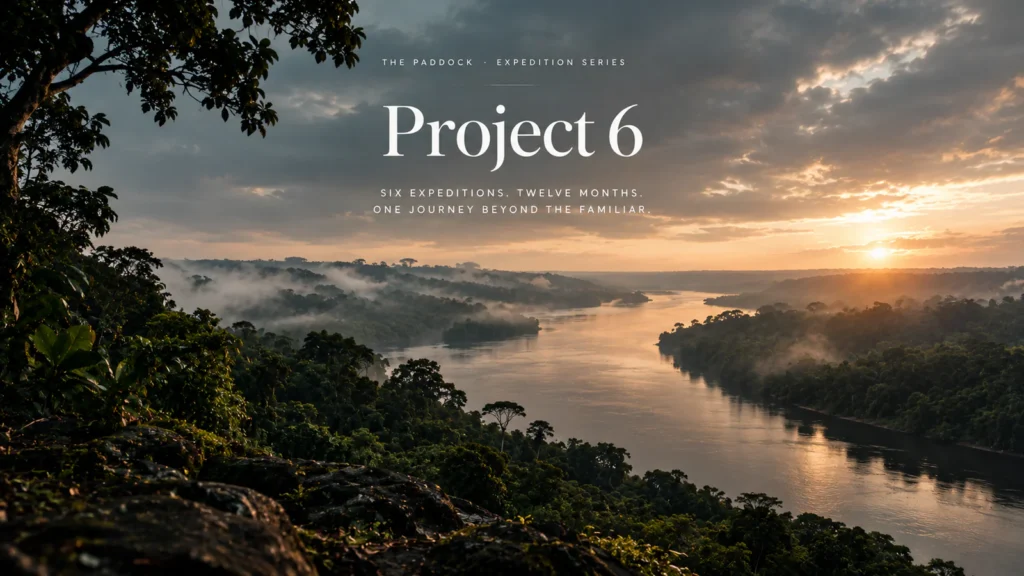
Six expeditions. Twelve months. One journey beyond the familiar.
Welsh adventurer Ash Dykes takes on six extraordinary expeditions in twelve months. Follow the first mission along the Sangha River, where remote rainforest, unexpected setbacks and the realities of exploration shape the journey.
Discover Project 6 ✦