
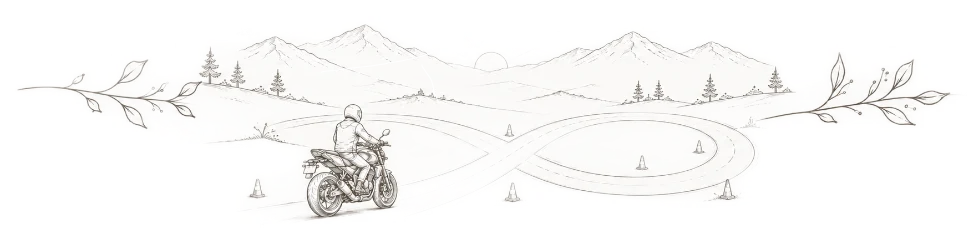
Slow Slalom
AVB Motorcycle Test
The slow slalom is, for many learners, one of the most challenging exercises in the AVB motorcycle test.
It might sound strange at first. After all, you are riding at walking pace.
But that is exactly what makes it difficult.
A motorcycle is built to move. Once you slow it down to near walking speed, you can no longer rely on momentum. Instead, you have to actively manage balance, vision, clutch control and the rear brake — all at the same time.
Everything comes together in one continuous, controlled motion.
What makes this exercise so important is that it teaches you how to keep a motorcycle calm and stable in situations where there is almost no speed to rely on.
And that becomes useful in real life. Think of a crowded festival car park, riding between pedestrians, or carefully controlling the bike on wet or slippery surfaces. In all of these situations, the principle is the same:
Keep the motorcycle stable, even when the pace is slow.

How do you do it?
In the slow slalom, you ride between a series of cones placed relatively close together. The speed is walking pace — which is exactly why it becomes difficult.
This exercise is not just about steering. It is about balance while the bike almost feels like it is standing still.
You continuously work with clutch control, rear brake and body balance to keep the motorcycle moving smoothly.
The examiner is not only checking whether you hit cones or follow the line correctly. They are mainly looking at control.
Is the ride calm?
Is it stable?
Or does it feel rushed and messy?
To perform the exercise properly, you hold the clutch at the friction point — just enough drive to keep the engine from stalling, but not enough to accelerate.
The rear brake is used to control speed. At this level of riding, the bike will often want to move faster than intended — the rear brake keeps everything in check.
Your body stays relaxed, and your focus is always ahead, not on the cone you are passing, but on the next one.
That forward vision is often the difference between instability and control.
The further ahead you look, the smoother the bike becomes.

Where it goes wrong
The biggest challenge in this exercise is tension.
Many learners become stiff in their arms and try to physically steer the bike through the cones. That usually creates instability.
Another common mistake is looking at the cone you are currently passing. A motorcycle tends to follow your gaze — and that often leads you exactly where you are looking.
Some learners also reach for the front brake when things feel unstable. At low speed, this usually makes things worse. The rear brake is your tool here — the front brake is not.

Tips
- Look at the next cone, not the one next to you
- Keep your arms relaxed
- Lightly grip the bike with your legs
- Use the rear brake to control speed
- Keep the clutch at the friction point
- Trust the motorcycle more than you think you can
- Avoid the front brake

My experience
For me, this was one of the hardest exercises in the entire AVB training.
Riding a heavy motorcycle at walking pace felt unnatural at first. Whenever I lost balance, I instinctively tried to correct it with the handlebars or by putting a foot down.
What changed everything was learning to relax.
The moment I started looking further ahead — towards the next cone instead of the one in front of me — the exercise became smoother.
I also noticed something important: instead of fighting the bike, it worked better to guide it gently from my hips and let it move naturally.
And at first, I focused too much on going slow. Later I realised it works better when you simply ride as slowly as possible — without obsessing over speed itself.
In the end, this exercise taught me something simple: You do not control a motorcycle by forcing it. You control it by trusting it.


Official CBR description
“The compulsory exercise in the second cluster is the slow slalom. There is no fixed speed requirement. Given the short distance between the cones, a walking pace is expected. The use of a slipping clutch is mandatory. The combination of correct control, slow riding and maintaining balance is essential. The cones must not be touched.”

← Previous exercise
Current exercise
Slow slalom
Next exercise →
IRON & GRACE • Riding Notes
If you enjoyed this, you might also like:
Motorcycle licence journey
From your first lesson to riding independently.
Dutch CBR motorcycle licence system
Basic vehicle control test: AVB
The first time a motorcycle really starts to feel like yours. Dutch AVB test (CBR off-road manoeuvring)
AVB exercises explained
Everything you need to know about the AVB manoeuvring exercises. Dutch CBR AVB exercises