Iron & Grace • The Rider • Motorcycle Licence • AVB • AVB Exercises Explained
Precision Stop
With an emergency stop, the aim is to bring the motorcycle to a halt as quickly as possible. With a precision stop, it’s all about where you come to a standstill. It requires a different approach to braking: rather than simply reducing your speed, you need to judge the distance carefully and bring the motorcycle to a controlled stop at exactly the right place.
It’s a skill you’ll use regularly in everyday traffic. Whether you’re approaching a stop line, waiting at a traffic light or moving slowly in traffic, you need to know where you want to stop and keep the motorcycle under control along the way.
This exercise is less about braking hard and more about control, timing and judging distance.
How does it work?
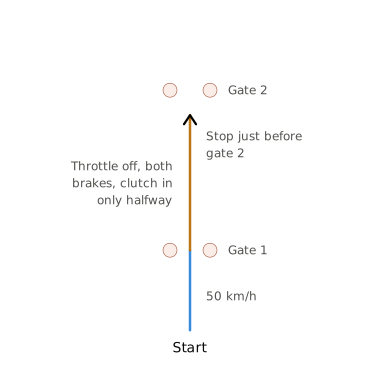
You approach the exercise at approximately 50 km/h. As soon as you pass through the first gate, you begin braking in a controlled manner. The aim is to come to a complete stop seventeen metres further on, just before the second gate.
Use both the front and rear brakes, applying pressure smoothly and evenly. As you slow down, shift down into first gear. Just before coming to a standstill, gradually ease off the brake pressure to avoid an abrupt stop.
Once the motorcycle has stopped, put your right foot on the ground.
It sounds straightforward, but judging the distance is what makes this exercise challenging. There is very little room to make corrections once you’ve started braking.
Where can things go wrong?
One common mistake is becoming too focused on the stopping point. You naturally want to know exactly where you’ll end up, but looking down at the stop line takes your attention away from the road ahead and can affect your balance. Keep looking forward and learn to judge the distance without constantly searching for the stopping point.
Braking pressure is another challenge. If you start braking too late, you’ll have to make bigger corrections towards the end. Start too early, and you risk stopping before the intended point. Some learners try to make up for this at the last moment, when what really matters is maintaining a smooth and consistent braking action.
It’s also easy to forget to shift down into first gear. Since you’re performing several actions at once, it helps to stay relaxed and follow a consistent sequence.
Tips
- Make sure you’re riding at a steady 50 km/h before starting the exercise.
- Begin braking as you pass through the first gate.
- Use both the front and rear brakes, applying pressure smoothly and evenly.
- Keep looking ahead rather than focusing on the stopping point.
- Gradually ease off the brakes just before coming to a standstill.
- Shift down into first gear while slowing down.
My experience
Of the three braking exercises, I found the precision stop perhaps the most challenging. Not because braking itself is particularly difficult, but because you need to develop a feel for how much distance you have left and how much braking pressure you need.
With an emergency stop, the objective is clear: stop as quickly as possible. The precision stop is different. You need to judge where you want to end up while you’re still moving and adjust your braking accordingly. Easier said than done.
At first, I found myself thinking about every little thing. You’re riding at speed, start braking and try to work out how much room you have left. Sometimes you think you’ve got it just right, only to stop a little too early or a little too late. After a few attempts, you gradually develop a better feel for the distance. You begin to trust your judgement more and find that you no longer have to think about every individual movement.
Official CBR description
“In the precision stop, the goal is to come to a stop just before the second gate. You first ride at 50 km/h and begin controlled braking when passing the first gate of two cones. You then bring the motorcycle to a stop 17 meters further on. The braking must be smooth and consistent using both brakes, without major corrections in braking force. Just before coming to a stop, you shift down into first gear.”
Discover More
Getting your motorcycle licence is just one way to explore the world of Bonvia. There is so much more to discover.
Hub
AVB Explained
Every AVB exercise has its own purpose and challenge.
From slow manoeuvres that test your balance to exercises that call for quick reactions and precise control. Explore the exercises one by one, discover how they are performed and learn what to pay attention to.
Discover AVB Explained ✦