Bonvia Stories • The Art of Writing • Literary Worlds
A House Made of Words
Jane Austen, Pemberley and what words can do
Some stories do more than take us somewhere else. They stay with us long after the last page, and sometimes they make us want to find those places for ourselves.
For me, that world first came alive through a television screen.
I was fifteen when my English teacher recommended the BBC adaptation of Pride and Prejudice. It was in English, with Dutch subtitles, and what began as a suggestion from school soon became something rather more. I became fascinated by the story, the characters and, just as much, the world in which they lived. I added Jane Austen’s novel to my reading list, eventually bought my own copy, and found myself returning to the series time and time again. I must have watched it thirty times by now.
Hearing the words
I watched the series first and only afterwards turned to the book. Reading it in English was hard work, but I wanted to hear those words for myself.
And I did hear them. Somewhere on the page, I could hear Mrs Bennet calling out, exactly as she had in the series. I could see Elizabeth arriving with her muddy dress, looking nothing like the carefully composed young women around her. The series had given me the voices and the faces; the book gave me the words behind them.
But the book also showed me something the screen had only hinted at. Charlotte Lucas, whom I had initially understood as a woman who sacrificed herself by marrying Mr Collins, began to look different on the page.
Charlotte is not blind to the shortcomings of the man she marries. She knows perfectly well that Mr Collins is not a romantic choice. But she also understands the world she lives in. As a woman without a fortune, her prospects are limited, and marriage offers her a home and a degree of financial security that she might otherwise struggle to find.
When she tells Elizabeth that she is not romantic and asks only for a comfortable home, her decision becomes easier to understand. Elizabeth sees it as a compromise she could never make. Charlotte sees it as a practical choice, made within the possibilities available to her.
I began to realise that Austen was not simply asking us to admire one character and disapprove of another. She was showing us how differently people can look at the same world, depending on their circumstances and what they need from life.
It was the first time I really noticed how much a few well-chosen words can do.
A small world, seen sharply
Jane Austen did not write grand adventures. Her stories take place in drawing rooms, ballrooms and country lanes, among families who have a great deal to lose. Yet she found an extraordinary amount to say within that relatively small world.
Beneath the romance lies a very real concern. The Bennets’ estate was entailed, which meant the five sisters could not inherit it, and Longbourn would pass to a male relative, Mr Collins. Their future was therefore far less secure than it might first appear. It is why Mrs Bennet’s constant matchmaking is comic and desperate at the same time.
Austen rarely needs to explain the world around her in lengthy passages. She lets her characters reveal it. A remark gives someone away, a conversation exposes an entire social order, and a seemingly ordinary exchange can say more than a long explanation. Mr Collins’s endless speeches and Lady Catherine’s sense of entitlement are never just entertainment. Through them, Austen reveals the assumptions, expectations and inequalities of the society in which her characters live.
Perhaps her greatest strength was her ability to observe people so closely. She wrote about a relatively small world, but understood its people with remarkable precision. Their pride, insecurities, ambitions and misunderstandings still feel recognisable, even when the rules of their society are very different from our own.
And she did it for a world I had never seen, in a language that was not my own, and I understood it anyway. That, to me, is what a good writer can do.
A house that only exists in words
There is one place in the story I have always found a little magical: Pemberley.
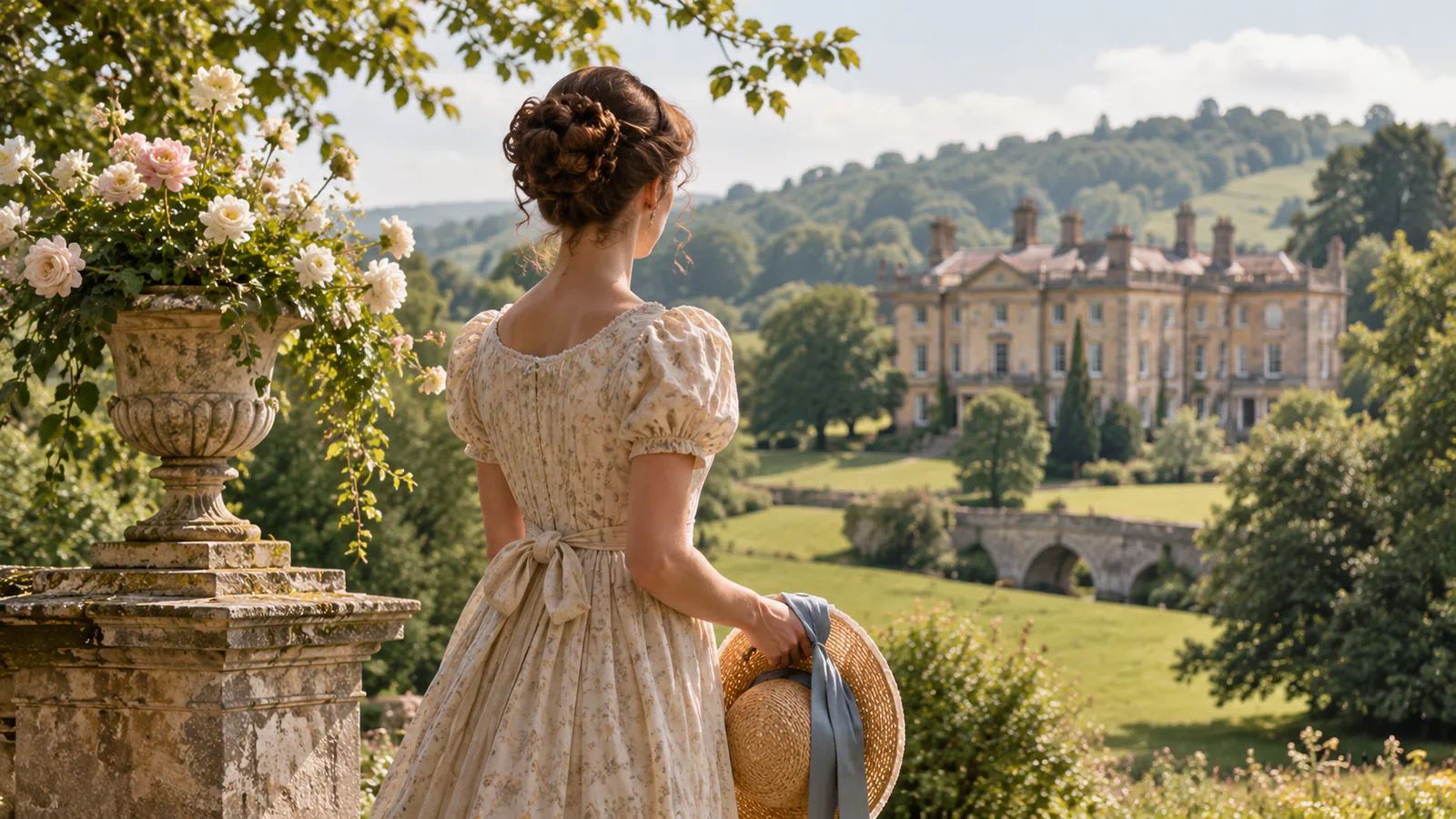
Pemberley does not exist. It is a house made of sentences, and yet two real country houses have become its face for different generations. For viewers of the 1995 BBC series, it is Lyme Park in Cheshire. In Joe Wright’s 2005 film, it is Chatsworth House in Derbyshire. Both look like places we might imagine Darcy calling home, because Austen’s words got there first.
But Pemberley is more than an impressive country house. It is also an important moment in Elizabeth’s story. Darcy’s letter has already shaken her opinion of him, but at Pemberley, after hearing the housekeeper speak so warmly of him, she begins to see another side of his character. Her doubts begin to shift.
The house does not change Darcy, of course. It changes what Elizabeth is able to see.
In the novel, Elizabeth discovers Pemberley while travelling through Derbyshire with her aunt and uncle. For me, as a reader, there was a similar moment of recognition: the realisation that a place can feel real long before you have ever been there. A few descriptions, a particular atmosphere and the imagination do the rest.
Another Darcy, another generation
The story continues to find new audiences, and each generation brings its own interpretation to the screen. The six-part Netflix adaptation, starring Emma Corrin as Elizabeth Bennet and Jack Lowden as Mr Darcy, offers another perspective on Austen’s world. It is written by Dolly Alderton and directed by Euros Lyn.
I’m curious, of course. Will we get to know all five sisters? Will Charlotte’s decision get the attention it deserves? And how will this Darcy compare with the one I have known for so many years?
I don’t need to decide in advance which version is best. Every adaptation brings its own interpretation, just as every generation meets the book from a different perspective.
That is one of the things I love most about returning to a story. The words remain the same, but we do not. Characters we once understood in one way begin to reveal something different, and familiar scenes take on a new meaning. A good story leaves room for that.
The road to Pemberley
At fifteen, I was drawn into this world by a television series and the recommendation of an English teacher. Since then, the book, the series and the film have each offered another way back in. And somewhere along the way, I started to wonder about the places too.
I would still love to visit those houses, explore the countryside of Derbyshire and drive along those quiet English lanes. Not because I imagine life in the Regency period was better; it certainly was not for everyone. But because there is something special about standing in a place that has lived in your imagination for so long.
A book can take us to another century. A film can give it a landscape and a face. And sometimes, years later, we find ourselves wanting to make the journey for real.
So whenever Elizabeth and Darcy return to the screen, I’ll be watching with one eye on the story and the other on the scenery, already wondering which road leads to Pemberley.
Next, under Endless Roads: the route from Lyme Park to Chatsworth and Bath.
“Think only of the past as its remembrance gives you pleasure.”
— Jane Austen, Pride and Prejudice