Endless Roads
Road Trips
Roda de Isábena
The Smallest Cathedral, High Above the Pyrenean Valley
A Village High Above the Valley
As you follow the winding course of the Isábena valley, Roda de Isábena gradually appears on the horizon. High above the landscape, stone houses cluster close together around the silhouette of an ancient cathedral. Far below, the river winds through the valley, with the mountains of Aragón stretching away beyond it.
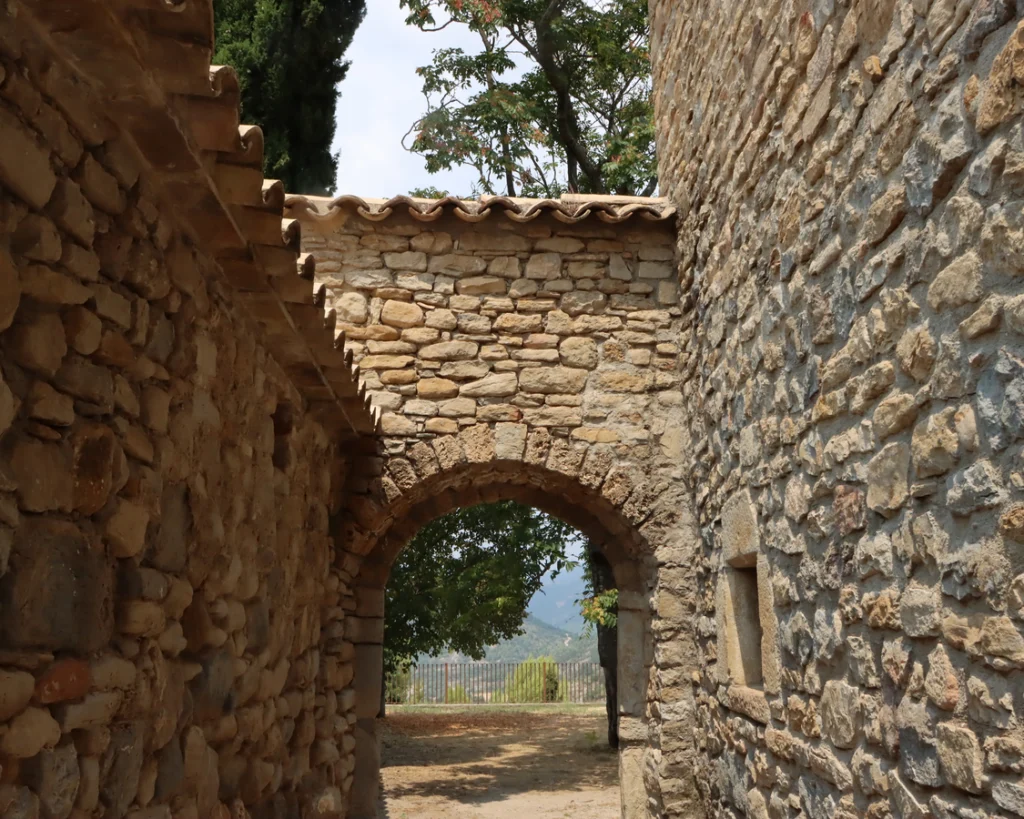
From a distance, the village seems almost to have grown out of the rock itself. Its houses follow the contours of the high rocky outcrop on which Roda was built, giving it a very different presence in the landscape from the settlements scattered along the river below.
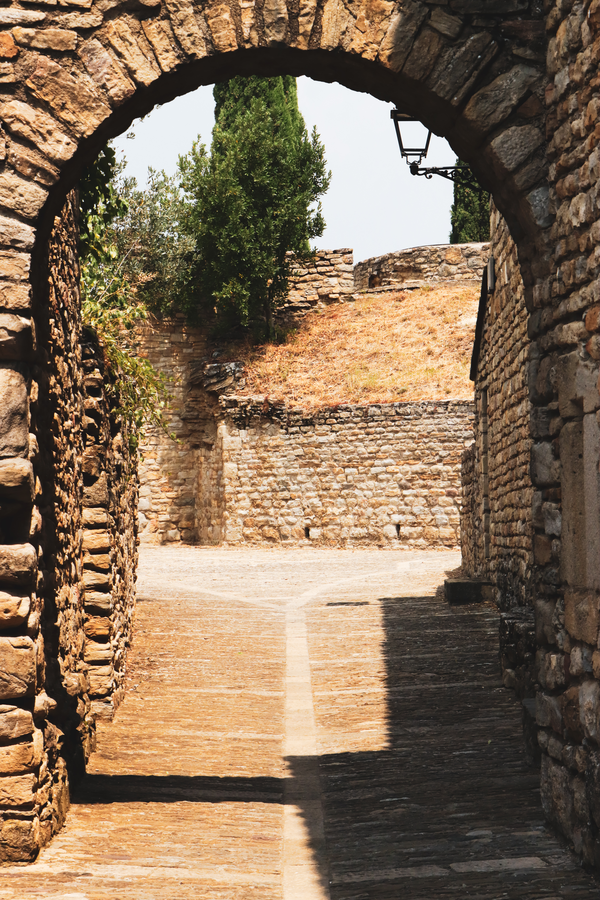
The road up is short and, at first glance, unremarkable: a mountain road of the kind you find throughout the Pyrenees, with sharp bends and barely any traffic. Its only real destination is the village at the end. Leave your car or motorbike in the car park below and walk the final stretch. It takes little effort, yet somewhere along the way you may notice yourself beginning to slow down.
The first thing you notice on arrival is the silence. There is no hurry, only the sound of your own footsteps on stone. Do not expect a spacious square lined with terraces or a village built around the needs of tourism. Roda keeps a modest profile, which seems fitting for a place that was once far more important than its present-day appearance might suggest.
A Strategic Position in the Pyrenees
Roda de Isábena lies in Ribagorza, a historic region in the north-east of Aragón. Built on high ground above the river, the village commanded views across the valley and the routes leading through the mountains. In the tenth century, this position carried considerable political and military importance, while the rocky terrain offered a natural advantage for defence.
Closely connected to the medieval County of Ribagorza, Roda gradually became a religious centre whose importance seems almost impossible to reconcile with the small village we see today. Something of that former status can still be read in the compact layout of the settlement, the remnants of its defensive works and the position of the former cathedral. At a time when faith, power and security were closely intertwined, Roda was much more than an isolated mountain settlement.
The Smallest Cathedral in Spain
At the heart of the village stands the former Cathedral of San Vicente. Everything in Roda still seems to gather around it, even though the village itself has long since grown quiet.
The first cathedral was consecrated here in 956, when Roda became the seat of a bishopric. Its early history was far from peaceful. In 1006, the settlement was attacked by the forces of Abd al-Malik, the son of Almanzor, and important buildings, including the cathedral, were destroyed. Reconstruction began in the eleventh century, continued over several centuries and was not completed until the thirteenth. The complex continued to evolve in the years that followed, leaving the building we see today marked by several different periods of history.
Roda de Isábena is often described as the smallest village in Spain with a cathedral. The description calls for a little context: in 1149, the episcopal seat moved to Lleida, and Roda lost its position as a bishopric centre. San Vicente remained an important religious monument, however, and it still stands at the heart of the village.
The cathedral is a fine example of early Romanesque architecture, with Lombard Romanesque features particularly visible in the decoration of its apses. You do not need to be an architectural expert to sense that this is more than simply an old and beautiful church. Its three naves, crypts and carved capitals speak of a community that helped shape life in this part of the mountains for centuries.
It is the cloister that stays with you most.
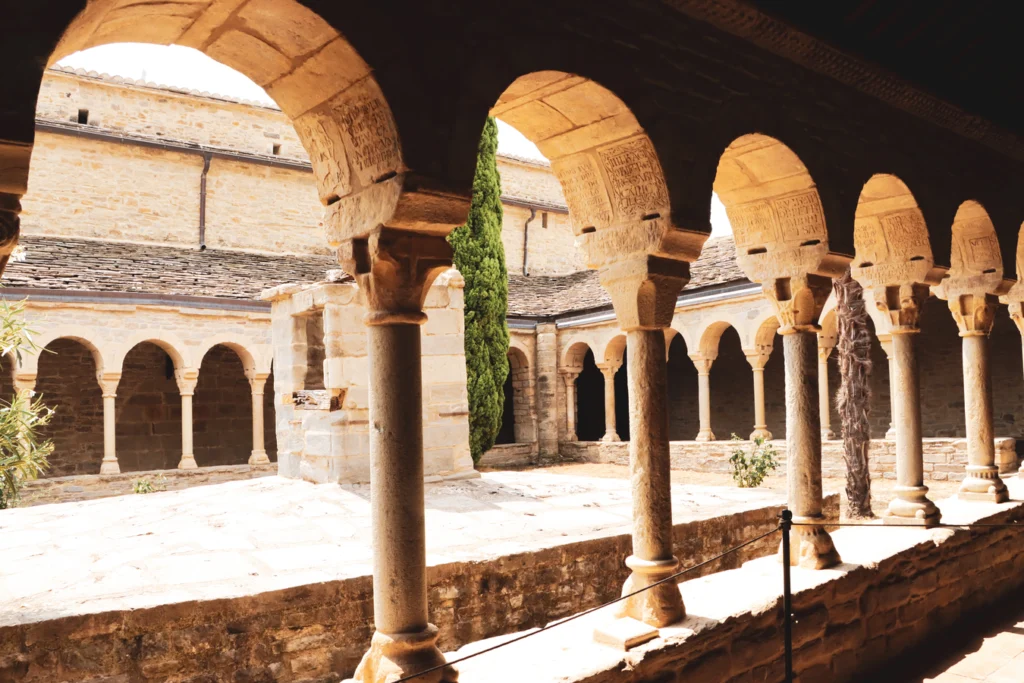
You step out of the half-light of the gallery into a courtyard filled with daylight, where the sandstone takes on a warm, golden hue. Through the arches, a dark cypress rises against the stone, a single vertical line among all those gentle curves. It is the sort of place that makes you slow your steps without quite knowing why.
Above you, names and commemorative inscriptions are carved into the stone, small traces of people who lived, prayed and mourned here centuries ago. You are quite literally walking beneath them. Most of their stories have been lost to time.
Yet the story of San Vicente did not end in the Middle Ages. There is a much more recent chapter, too, involving works of art that disappeared and did not all find their way home.
The Lost Treasures of San Vicente
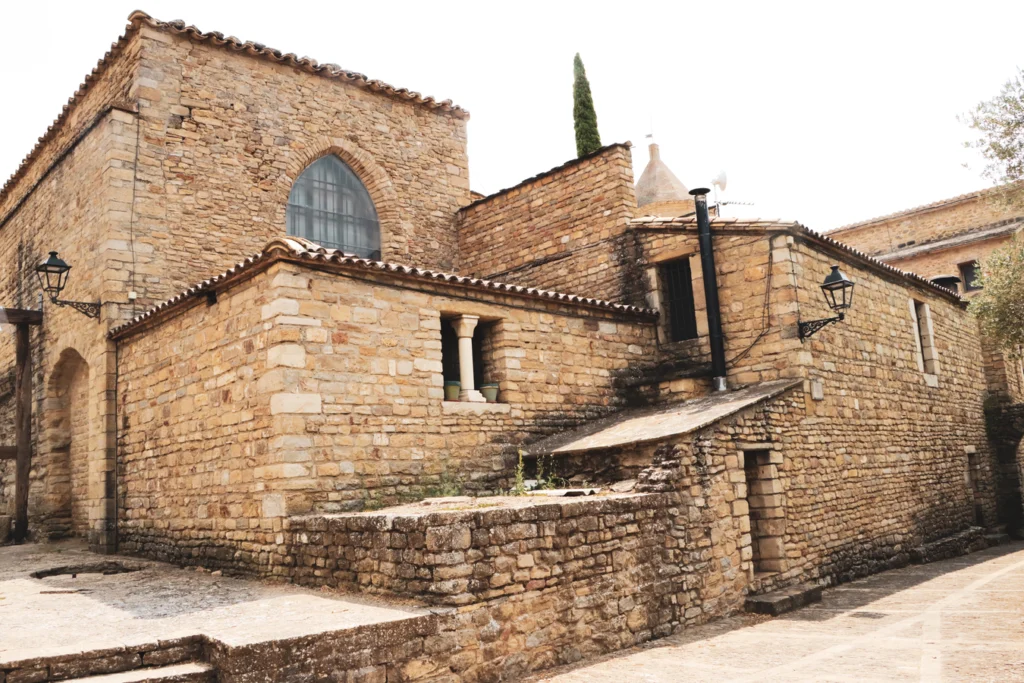
On 7 December 1979, the cathedral was robbed. Several valuable objects disappeared, including the medieval chair of San Ramón. The Belgian art thief Erik the Belgian, also known as Erik el Belga, was linked to the robbery.
The chair was no ordinary piece of furniture. It was an object closely bound to the cathedral’s history, and during the theft it was sawn into pieces. Some of the fragments were later recovered and reassembled, with transparent material separating the sections. The marks left by the robbery are still visible today.
A historic tapestry, known as De la Virgen y San Vicente, was also stolen. It depicts the Virgin Mary and Child alongside several saints associated with Roda’s history. For years, its whereabouts remained uncertain, until it was discovered in Houston, United States, in 2012. In April 2013, it was officially returned to Spain. Following examination and restoration, it was placed in the Museo de Huesca. It had made its way back to Spain, then, but not to the place where it had been kept for centuries.
Today, as you walk through San Vicente, the walls seem to have endured the passing centuries almost untouched. The theft is a reminder that even places like this remain vulnerable. Not everything that survived for hundreds of years is still here.
Where Medieval History Meets Gastronomy
The former Cathedral of San Vicente has found a surprising new purpose, too. Part of the complex now houses the Hospedería de Roda de Isábena, with a restaurant located in the former refectory.
The room where members of the religious community once gathered to eat now welcomes visitors who come to enjoy the cuisine of the region. It is a remarkable continuation of the building’s original purpose. The people have changed, as has the way the space is used, but the idea of coming together around a meal has endured.
That, too, is part of Roda’s appeal for travellers looking for more than a monument to admire briefly before moving on. Here, architecture, local food and the atmosphere of an old mountain village come together.
A meal in such a historic setting can add another dimension to a visit. The stones are not the only things that tell a story; the way the place is used today also connects its past with the present.
It is worth checking in advance whether the restaurant is open and whether a reservation is required. Opening hours and availability can change, particularly in smaller places away from the busiest tourist routes.
Walking Through Another Time
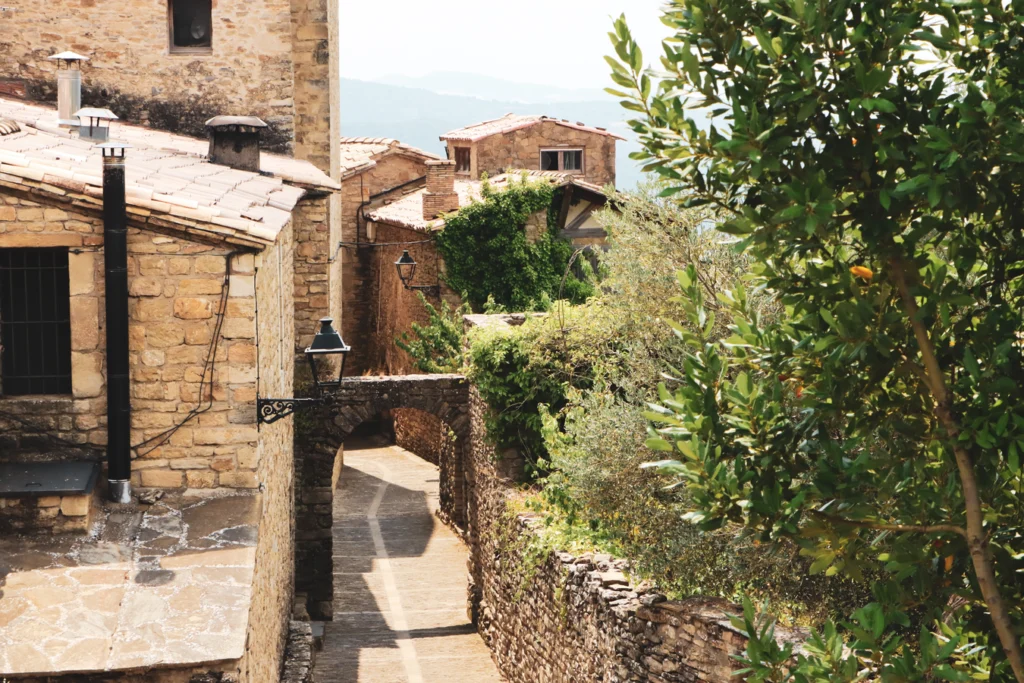
Beyond the cathedral, it is the narrow streets that hold your attention. They wind between traditional houses, with small squares appearing unexpectedly between the façades. The sixteenth-century Prior’s Palace, the remains of the defensive works and the Romanesque buildings reveal how different centuries have left their mark on the village.
Roda is also a good starting point for exploring the rest of the valley, but the village itself deserves more than a hurried visit. Take your time wandering through the streets, and stop now and then to look out across the landscape.
A Small Place with a Great Past
Roda de Isábena is a reminder of how much history can belong to a very small place. High above the river, a settlement grew into an important religious centre. Then the world changed: the episcopal seat moved elsewhere, and the village lost its former standing. Its historic heart, however, endured.
Roda does not need to make a grand display of its past. You discover it in the village’s position above the river, in a narrow street and in the walls of San Vicente.
Those who take the time to wander here will find that some places do not tell their stories loudly. All you need to do is follow the road uphill and pause for a while to listen.
“Some places preserve their history not behind glass, but in the stones people still walk past every day.”