
Bonvia Stories · Flavour & Fire · Sourdough · Starter
Your First Steps with Sourdough
Everything you should know before creating your first starter.
Creating a starter may seem like a small beginning, but it marks the start of a completely new way of making bread.
You do not need a special kitchen or years of experience. With flour, water, and a little attention, you can build something that slowly comes to life.
Before you begin, there are a few things that help you understand the process better. About time, patience, care, and the small habits that help your starter grow into a healthy, active culture.

More than just flour and water
A starter begins with something simple: flour and water. But what develops from that is much more than a mixture in a jar.
As the days pass, wild yeasts and lactic acid bacteria develop into a living culture. A small ecosystem that you learn to care for, observe, and understand.
Over time, a starter almost becomes part of your kitchen. It sits on the counter, receives attention, responds to its surroundings, and slowly develops its own character. Some people even give their starter a name — not because it needs one, but because something you care for every day naturally starts to feel familiar.
In the beginning, sourdough is not about achieving perfect results. It is about learning to notice small changes. A few bubbles. A different aroma. A starter that slowly becomes stronger.
Give it the time to find its own rhythm. Every starter develops differently, and that is exactly what makes the process so special.
Before you start with sourdough
A good start makes the entire process easier. A few simple habits help your starter grow healthy and prevent many common beginner problems.
Use a clean glass jar
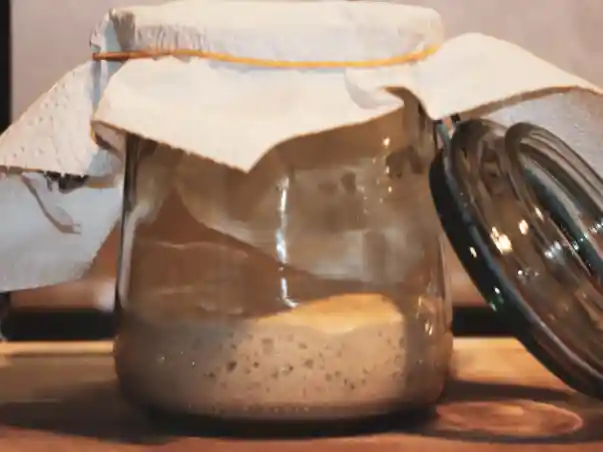
Always start with a clean jar. Old residue or dirt can affect the development of your starter. A transparent glass jar also makes it easier to see activity, growth, and changes over time.
Do not pour starter discard down the sink
A small amount may seem harmless, but flour can build up and eventually cause blockages. Instead, throw discard away or save it to use later in other recipes.
Give your starter a consistent place
A starter thrives on consistency. Choose a place where the temperature remains fairly stable and where you will easily see it. What you see, you are more likely to remember.
A Schedule Is a Guideline
A schedule helps you understand the process and gives you a sense of direction, but a starter is not a checklist that you simply tick off. It is a living culture that responds to its environment. In warmer conditions, it will often become active more quickly, while in cooler surroundings it will develop at a slower pace. Learn not only to follow the days, but to pay attention to what your starter is telling you.
Do not expect perfection in the first days
A starter needs time to develop a stable rhythm. Sometimes a lot seems to happen, and sometimes almost nothing happens at all. Both can be part of the process.
Look, smell, and learn
Your starter tells you a lot when you pay attention. Small changes in aroma, texture, and activity help you understand what is happening.
Give your starter a name
Many bakers notice that, over time, a starter becomes more than just an ingredient. It lives on the kitchen counter, receives attention, and slowly becomes part of your daily rhythm. Some people even give it a name. Not because it is necessary, but because something you care for every day naturally starts to feel familiar.
A Small Companion in Your Kitchen
Many bakers find that, over time, a starter becomes more than just an ingredient. It sits on the kitchen counter, receives daily attention, and gradually becomes part of the rhythm of the kitchen.
Some people even give it a name—not because they have to, but because something you care for every day naturally begins to feel familiar.
The start of something living
A starter does not begin with perfection, but with attention. The first days may seem small, but somewhere between flour, water, and time, something begins to develop its own character.
Give it the space to grow. The most beautiful part of sourdough is not only the bread that eventually comes out of the oven, but the connection you build with the process along the way.
Every starter has a beginning. Yours starts with three simple things: flour, water, and patience.
Continue your journey
The Sourdough Journal
Explore every part of sourdough, from starters and baking to discard.
The Living Starter
Begin where every loaf begins: create, feed, and understand your starter.
The Baking Process
From dough to oven: discover the techniques, steps, and moments that bring a loaf to life.