
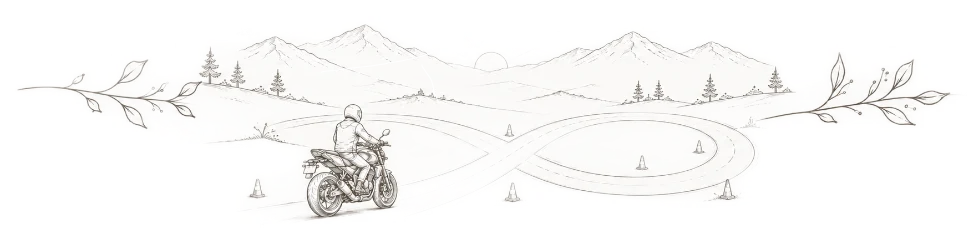
Motorcycle AVB Test
The first time a motorcycle truly starts to feel like yours
For many riders, this is the part they worry about most.
Not because the test itself is particularly complicated, but because it is often the first time you genuinely learn how to work with a motorcycle.
A motorcycle is not a bicycle. It is not a scooter. And it certainly is not a car.
It is heavier than you expect, responds differently than you imagine, and in the beginning can seem determined to do exactly the opposite of what you intended.
The first lessons often feel unfamiliar. Sometimes even a little chaotic.
You release the clutch and stall. You try to steer, shift gears and listen to instructions all at the same time, while your hands and feet are still learning movements that have not yet become natural.
There is nothing unusual about that.
Almost everyone starts there.

What is the AVB test really about?
AVB stands for Vehicle Control. In practice, however, it is about something much simpler: learning to work with the motorcycle rather than against it.
You learn what slow-speed riding actually feels like. You learn where to look in a corner, how to brake without tension, and how to let the motorcycle do what it was designed to do.
It is less about strength and more about calmness, control and trust.
At some point, things that once felt complicated begin to feel natural. The slalom becomes smoother. A braking exercise becomes less intimidating. A manoeuvre you once dreaded suddenly works without much thought.
Not because you have become stronger, but because you have become more relaxed.
And that is usually the moment when everything starts to click.
→ Explore all 12 AVB exercises – explained step by step ✦

The moment it starts to make sense
Almost every rider experiences a moment when something shifts. Not dramatically. Not even consciously. But something that felt difficult the week before suddenly works.
A braking exercise improves because you finally commit to the brakes. A slalom becomes smoother because you stop forcing the motorcycle through it. During the figure-of-eight, you realise that where you look matters far more than what your hands are doing.
Slowly, the motorcycle changes from something you constantly think about into something you simply ride.
And perhaps more importantly, you stop focusing on doing everything correctly. You start focusing on riding.
That small change often makes all the difference.

What is the examiner actually looking for?
Many learners assume the AVB test is about the one exercise they keep struggling with. The slow slalom. The figure-of-eight. The braking test that never seems to go quite right.
In reality, the examiner is looking for something broader.
Can you remain calm when things are not perfect? Do you look where you intend to go? Can you maintain control when a manoeuvre does not begin exactly as planned?
And perhaps most importantly: How do you recover when something goes wrong?
That is where confidence becomes visible. Not in perfection, but in your ability to continue calmly when perfection is no longer possible.
The examiner is not looking for a flawless rider. They are looking for someone who can manage the motorcycle safely and confidently.

How do you know when you are ready?
For many learners, this is the hardest question of all. Not because they do not want the answer, but because there is rarely a single moment when everything suddenly falls into place. In fact, many people feel least prepared shortly before the test.
Yet somewhere along the way, something changes.
You climb onto the motorcycle and pull away without consciously thinking through every step.
The clutch. The gears. The steering. They move quietly into the background.
The motorcycle no longer demands all of your attention. Instead, there is space to look further ahead.
To read the road. To think beyond the next manoeuvre.
And often that is exactly the moment when an instructor looks at you and says:
“I think you’re ready.”

The real purpose of AVB
For many riders, AVB feels like an obstacle that must be completed before the real riding begins. But something far more important is already happening during this stage.
You are building the foundation for everything that comes afterwards.
Your first ride in traffic. Your first winding road. Your first ride in the rain. Your first solo journey.
AVB is not really about cones or exercises. It is about learning how a motorcycle moves, how it responds, and how much easier everything becomes when you stop fighting it.
Eventually, you notice that you are no longer forcing things.
You are simply riding.
And that is often where motorcycling truly begins.
→ Explore all 12 AVB exercises explained step by step ✦

IRON & GRACE • Riding Notes
If this article resonated, you might like to explore:
Motorcycle licence journey
From your first lesson to riding independently.
Dutch CBR motorcycle licence system
Explore more ✦
How much does a motorcycle licence cost?
About lessons, exams, gear and the investment most people don’t factor in.
Explore more ✦
Choosing a motorcycle school
A good instructor often makes more difference than you’d think.
Explore more ✦