Flavour & Fire • My Kitchen Table • Around the Fire
From Picanha to Pulled Pork: Barbecuing by Temperature
From a hot grill to hours of slow cooking: it’s all about timing and temperature.
A good piece of meat on the barbecue sometimes needs a little more attention than a few minutes over hot coals. Especially when you’re cooking larger cuts, such as picanha, a rolled bavette or pulled pork, you want to know what’s happening beneath the surface. The smell of a barbecue is wonderful, of course, but in the end you want the meat to be properly cooked, stay juicy and have exactly the flavour you’re looking for.
There are several ways to barbecue. You can cook meat directly over the heat, let it cook slowly using indirect heat, or combine the two methods. Many people stick to direct grilling, but larger cuts of meat can benefit enormously from a little more patience. Once you start paying attention to temperature, you may be surprised by how much more control you have.
Direct Grilling: Straight Over the Heat
For many people, barbecuing simply means direct grilling. Light the coals, put the meat or vegetables on the grate and keep an eye on things, turning them now and then and hoping nothing burns. That works perfectly well for a burger, sausage or thin steak. The food sits directly above the heat source and cooks relatively quickly.
Larger cuts of meat are a different matter. The outside is exposed to intense heat while that heat still has to travel towards the centre. As a result, the outer layers can become overcooked or even burnt before the middle has reached the desired temperature. There’s also less time to make adjustments.
Some people seem to enjoy a really blackened crust on their meat. A little char and a crisp, browned edge can be delicious, but burnt is something else entirely. Burnt pieces don’t just taste bitter; cooking meat until it is heavily charred can also produce unwanted compounds. Personally, I’d much rather have a beautifully browned outside and meat that’s cooked just right inside.
Indirect Grilling: Take Your Time
With indirect grilling, the meat isn’t placed directly above the coals or burner. Instead, you create a space where it can cook gently while the heat circulates around it. In a way, your barbecue starts to work like an oven.
The obvious downside is that it takes longer. But that’s also where the advantage lies. You have much more control over the temperature, allowing the meat to cook more evenly. This reduces the chance of the outside drying out while the centre is still not quite up to temperature.
Chicken is a good example. When you cook it directly over high heat, the outer parts can become dry and overcooked while the thickest part is still not sufficiently cooked. That’s exactly what you want to avoid. Chicken needs to be thoroughly cooked, but that doesn’t mean the outside has to be dried out in the process.
I also prefer indirect heat for a good piece of beef. It’s a shame when the outer edges are completely cooked through while the centre is still barely warm. That’s not the same as deliberately choosing rare or blue. The idea is to cook the meat evenly, with a centre that reaches exactly the level of doneness you want.
Indirect grilling is particularly useful for larger cuts and longer preparations. Think of picanha, rolled bavette, brisket or pulled pork. For low-and-slow cooking, a barbecue temperature of around 110–140 °C (230–285 °F) is often used. The exact temperature and cooking time depend on the cut, its size and the barbecue itself.
Indirect First, Direct Afterwards: The Reverse Sear
Direct and indirect grilling don’t have to be separate choices. In fact, combining the two can give you a wonderful result.
A good example is the reverse sear. You start by cooking a piece of meat, such as picanha, slowly over indirect heat until it is almost at the desired internal temperature. Then you move it over the direct heat for a short, intense sear. This gives the outside a beautifully browned, crisp crust without cooking the centre much further.
Another way to give meat a lovely crust is caveman style. Instead of placing the meat on the grate, you put it directly onto the glowing charcoal. It may sound a little unusual, but it can produce a delicious result. This method is best suited to a short, high-heat finish. Use clean, suitable charcoal without firelighters or other additives, and keep a close eye on the meat.
Both methods follow the same principle: cook the meat gently first, then give it a short burst of intense heat. You get that lovely crisp exterior while keeping the centre beautifully rare or medium. Picanha is particularly well suited to this approach. You can give the outside a final sear, perhaps with a little pepper or seasoning, without exposing the entire cut to high heat throughout the cooking process.
This is also where knowing the internal temperature becomes useful. You don’t want to move the meat over direct heat too early, but you don’t want to wait until it has already reached its final temperature either. A thermometer helps you get the timing right.
Larger Cuts of Meat Need a Little Attention
Not every cut of meat behaves in the same way on the barbecue. Its thickness, shape, fat content and preparation all influence how it cooks.
Picanha, for example, is a beautiful cut of beef with a layer of fat that adds plenty of flavour as it cooks. A rolled bavette is different again. Because the meat is rolled, its shape changes, and you also need to consider the filling and how the roll has been prepared.
Brisket and pulled pork are all about slow cooking. The connective tissue needs time to soften, and that can take several hours. Simply following the clock isn’t enough either; two cuts of meat of the same weight can behave quite differently.
Even smaller preparations can catch you out. I’ve had rib fingers wrapped in aluminium foil on the barbecue, only to come back an hour or two later and find that they’d gone much too far. They were practically burnt. That’s exactly the sort of situation where you realise it’s better not to rely on time alone. A barbecue keeps producing heat even when you’ve stepped away to do something else.
That’s why I like to know not only how hot the barbecue is, but also what’s happening inside the meat.
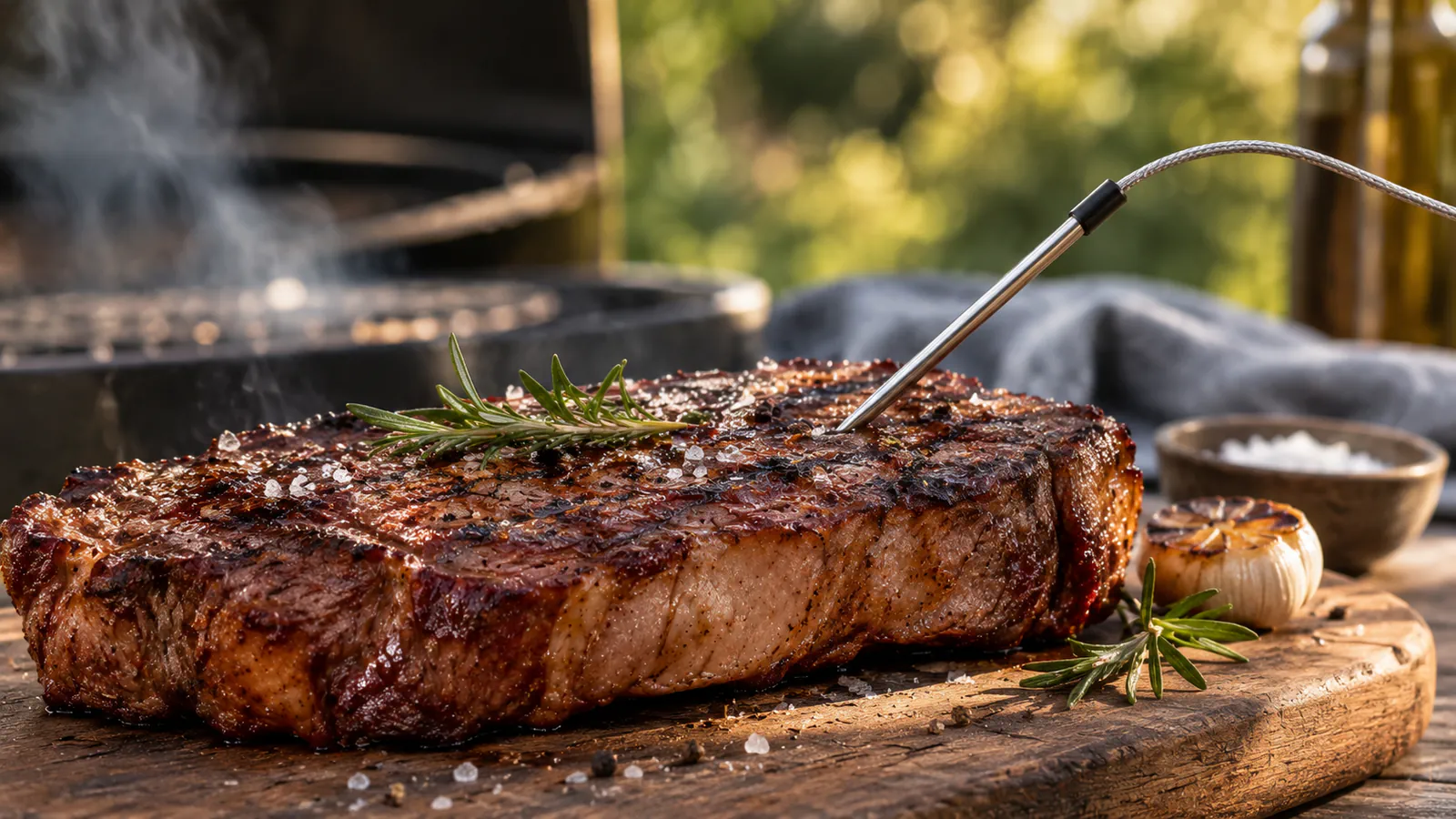
Internal Temperature: How Well Done Do You Like Your Meat?
The internal temperature is measured at the thickest part of the meat. It gives you a much better idea of how well it’s cooked than simply looking at the outside or relying on cooking time.
For a whole, intact cut of beef, you can use the following temperatures as culinary guidelines. They’re not exact rules: the final result can vary depending on the shape and thickness of the meat and the way you cook it.
| Doneness | Internal temperature |
|---|---|
| Rare | 48–52 °C (118–126 °F) |
| Medium rare | 54–56 °C (129–133 °F) |
| Medium | 58–62 °C (136–144 °F) |
| Medium well | 63–67 °C (145–153 °F) |
| Well done | 68–72 °C (154–162 °F) |
When cooking a larger cut of meat, it’s usually best to take it off the barbecue a little before it reaches your desired final temperature. The temperature can continue to rise while the meat rests. How much it rises depends on factors such as the size of the cut and the cooking method.
What About Chicken and Pork?
Not all types of meat require the same internal temperature. Chicken needs to be thoroughly cooked throughout. An internal temperature of 75 °C (167 °F) is a practical guideline. Always measure at the thickest part of the meat, making sure the probe doesn’t touch the bone.
Pork offers a little more flexibility. A whole, intact pork tenderloin or pork loin doesn’t necessarily have to be cooked until completely dry. For a juicy result, you can aim for around 63–65 °C (145–149 °F), followed by an adequate resting period. With minced pork, sausages and other products made from minced or combined meat, thorough cooking is more important.
Pulled Pork: Time and Temperature
Pulled pork is a different story altogether. The aim is to make the meat so tender that it pulls apart easily. An internal temperature of around 90–95 °C (194–203 °F) is a common guideline, but the thermometer doesn’t tell you everything. You can also check the meat with a probe or skewer. It should slide in with very little resistance. Ultimately, that’s just as important as the temperature reading.
Internal Temperature and Food Safety
Not every cut of meat can be prepared in the same way. With a whole, intact piece of beef, bacteria are generally found mainly on the surface. That’s why a steak or picanha can be served rare, provided the outside has been properly seared.
Chicken and minced meat are different. Harmful bacteria can also be present inside these products, so they need to be cooked thoroughly throughout. An internal temperature of at least 75 °C (167 °F) is a practical safety guideline.
It’s also worth paying extra attention to meat that has been stuffed, rolled or assembled from different pieces. When you roll a bavette, for example, surfaces that were originally on the outside can end up on the inside. Don’t automatically treat this kind of preparation as an intact cut of beef that can safely be served rare.
A thermometer helps you check the temperature in the right place. Measure at the thickest part of the meat and make sure the probe isn’t touching a bone. And, of course, good kitchen hygiene and keeping raw and cooked meat separate remain important.
Which Meat Thermometer Suits Your Way of Barbecuing?
There are several types of meat thermometer. Some are designed for a quick temperature check, while others are made to monitor the temperature throughout a long cooking process. I’ve used a few different types myself, and each has its advantages.
1. The Digital Instant-Read Thermometer
The digital instant-read thermometer is probably the most familiar type. It looks a little like a pen: you insert the probe briefly into the meat and get a temperature reading within seconds.
It’s affordable and useful for all sorts of things. You can use it for steaks, chicken and other cuts of meat, but also in the kitchen for sauces or caramel. I find it particularly handy when I just want to check something quickly.
For larger cuts that spend hours on the barbecue, though, it becomes less practical. You have to keep checking the temperature and opening the lid. That lets heat escape and means you have to keep returning to the barbecue. You also have to reach over the hot grill each time you take a reading.
2. A Wired Thermometer with a Separate Probe
With this type, the probe stays in the meat while it cooks. A heat-resistant cable connects it to a separate device outside the barbecue. You can follow the temperature on its display and often set an alarm for your desired internal temperature.
That’s useful for larger cuts and longer cooking sessions. You don’t need to keep opening the lid to check how the meat is doing.
I’ve used this type of thermometer myself. It works well enough, but the cable can get in the way when you’re placing a large piece of meat on the barbecue or want to move it around. Depending on the model, the connection to the device can also occasionally be unreliable.
3. The Fully Wireless Smart Thermometer
With a fully wireless thermometer, there’s no cable connecting the probe in the meat to the device. The temperature is transmitted via Bluetooth, Wi-Fi or a combination of both, to a base station or an app on your phone.
I find this particularly convenient when barbecuing. You can leave the probe in the meat and get on with something else, while still being able to follow the temperature without having to stand next to the barbecue.
Some models measure not only the internal temperature of the meat, but also the ambient temperature around the probe. That’s a useful extra feature. You can see how warm the meat is inside, as well as the temperature in the barbecue right where the meat is cooking.
For picanha, for example, you can follow the internal temperature and see when it’s almost time to move the meat over direct heat for its final sear. With brisket or pulled pork, it’s handy to monitor the temperature throughout a long cooking session. And even with smaller cuts, such as rib fingers, an alert can help prevent you from losing track of the cooking process.
There are several brands and models available, including MEATER and Vulpes Goods. Features vary, so it’s worth checking whether a thermometer only uses Bluetooth or also supports Wi-Fi for remote monitoring.
4. The Analogue Thermometer
The classic analogue thermometer has a metal probe and a round dial. It doesn’t need batteries and is straightforward to use. Insert the probe into the meat and read the temperature from the dial.
It’s a simple option, although readings are generally slower and less convenient to check than with a digital thermometer. Accuracy and response times can also vary between models. If you regularly cook larger cuts and want to monitor the temperature closely, a digital thermometer is usually more practical.
What About the Thermometer Built into the Barbecue Lid?
Many lidded barbecues come with a built-in thermometer. It’s useful, but it’s worth understanding what it actually measures. It tells you the temperature inside the barbecue, not the internal temperature of the meat.
That reading is particularly important when cooking indirectly or using low-and-slow methods. You need to know how hot the barbecue itself is. However, the temperature where the meat sits isn’t necessarily the same as the temperature near the top of the lid. The built-in thermometer measures at one fixed point and isn’t always particularly accurate.
A separate ambient temperature sensor positioned close to the meat can therefore be a useful addition. It gives you a better idea of what’s actually happening around your food.
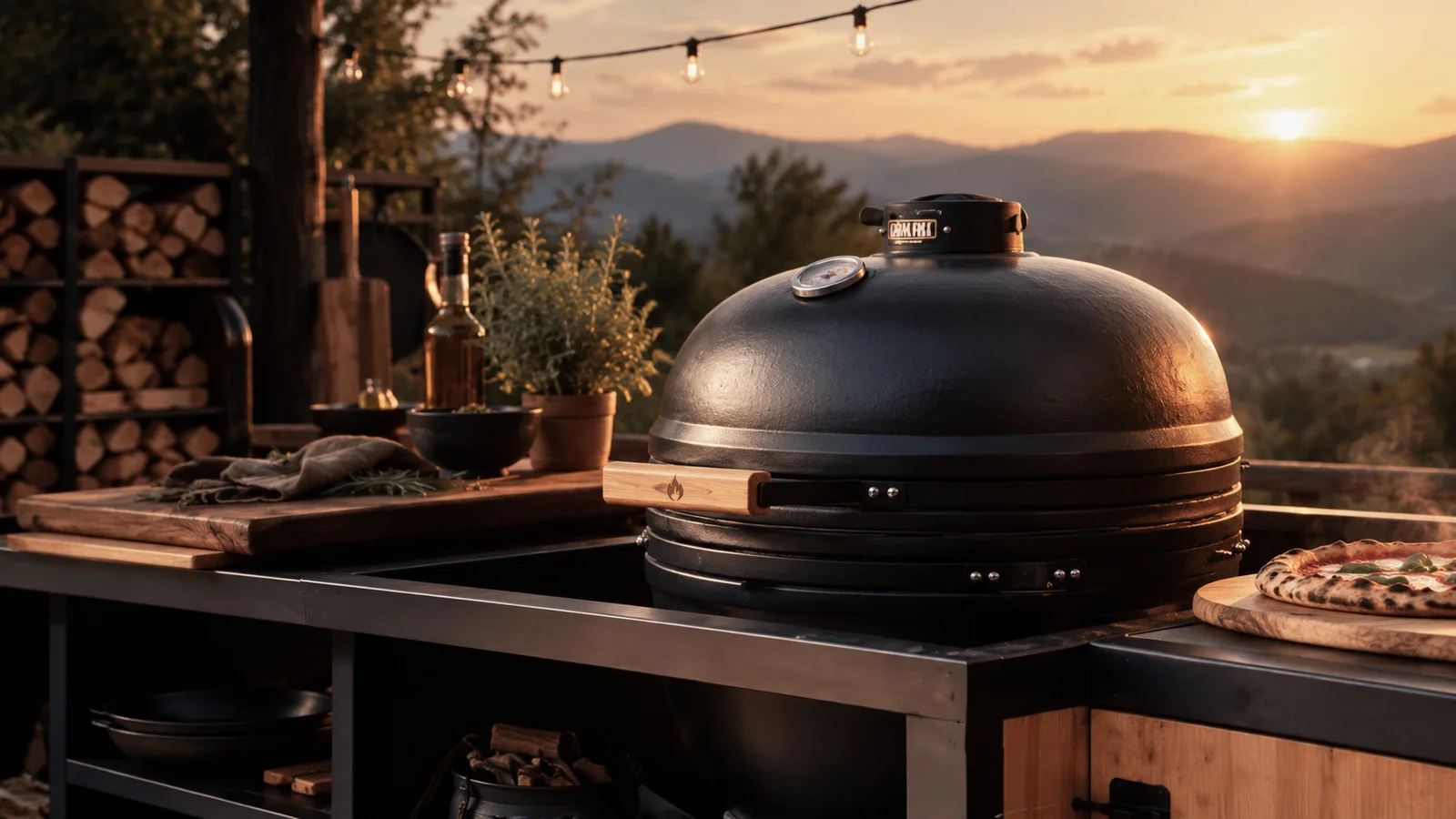
Wireless Monitoring While Barbecuing
After using both an instant-read thermometer and a wired model, I find a fully wireless thermometer particularly useful for longer barbecue sessions. The probes stay in the meat, and I can follow the temperature without constantly opening the lid or having to stay close to a separate device.
The thermometer I use has four separate probes. Each one measures both the internal temperature of the meat and the ambient temperature around the probe. This means you can monitor several pieces of meat at once and get a better idea of the temperature where they’re actually cooking.
The base station has its own display, and you can also view the readings in the accompanying app via Bluetooth and Wi-Fi. You can set temperature alerts to let you know when the meat reaches a particular temperature. According to the manufacturer, the probes are IP67 waterproof, dishwasher-safe and can be used for up to 25 hours after a full charge.
For me, the biggest advantage is simply the convenience. When cooking pulled pork or brisket for hours, I don’t have to keep checking how far along the meat is. And when I cook picanha indirectly before giving it a final sear over direct heat, I can judge much more easily when it’s time to make that move.
A Bonvia Find
A Little Recommendation
During longer barbecue sessions, I like being able to keep an eye on the temperature without constantly lifting the lid. That’s why I use this wireless meat thermometer. With four probes, you can monitor several cuts of meat at once, as well as the ambient temperature inside the barbecue. I find it particularly useful for picanha, brisket and pulled pork.
Find the wireless meat thermometer on bol →
Some links on this page are affiliate links. If you buy or book through one of these links, Bonvia may earn a small commission at no extra cost to you. This helps support our stories, recipes and discoveries. en dit in het nederlands
A Little More Attention Makes All the Difference
Barbecuing doesn’t have to be complicated, but it’s fun to look beyond simply putting meat on the grill. Sometimes you want to cook something quickly over high heat; other times, a good piece of meat deserves a long, gentle cook. And with picanha, the best result can come from combining both methods.
A thermometer won’t do the barbecuing for you. You still need to keep an eye on things, taste and decide what you enjoy. But it does help you understand what’s happening to the meat. And that makes it much easier to serve a beautiful piece of barbecue just the way you intended.